
 +38(068) 325-62-09
 +38(095) 127-41-92
 +38(093) 651-05-48
 (044)251-04-68, (044)251-05-00
Our customers often ask which cord is suitable for weaving a hammock.
There is no single answer, as it all depends on the type of hammock you are going to make and the technique of its production.
A hammock (from the English word hammock) is a suspended bed brought by the English from sea voyages, and was used by many peoples.

Hammock Weaving Technology
The technology for making a hammock is simple and quite accessible for self-production at home. There are many freely available guides on the internet showing various hammock-making techniques.
Types of Hammocks
There are two types of hammocks: woven from cord and fabric hammocks.
Woven Hammock
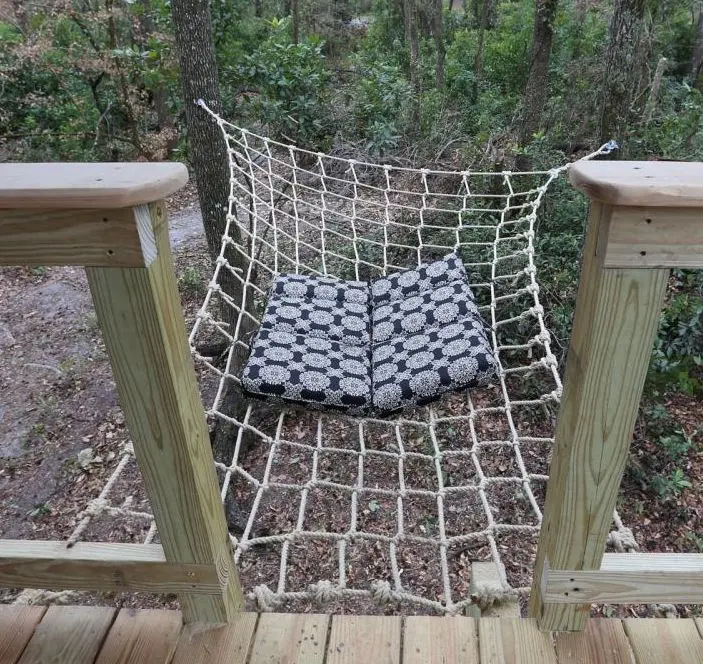
A woven hammock looks like a small basketball net: large cells between two thick guiding ropes.
Such a hammock is woven from thick (7-8 mm) rope. Cotton rope (cotton yarn) is usually recommended.
Macramé Woven Hammock
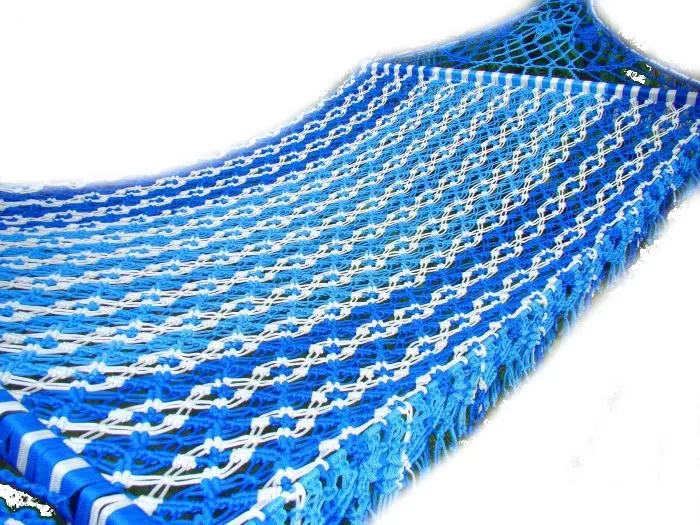
A woven hammock in the macramé style has a finer net or woven pattern. The guiding ropes can also be braided.
The macramé woven hammock can be woven from a single cord (thicker, about 7-8 mm) or from two cords (thinner, about 4-5 mm).
Fabric Hammock
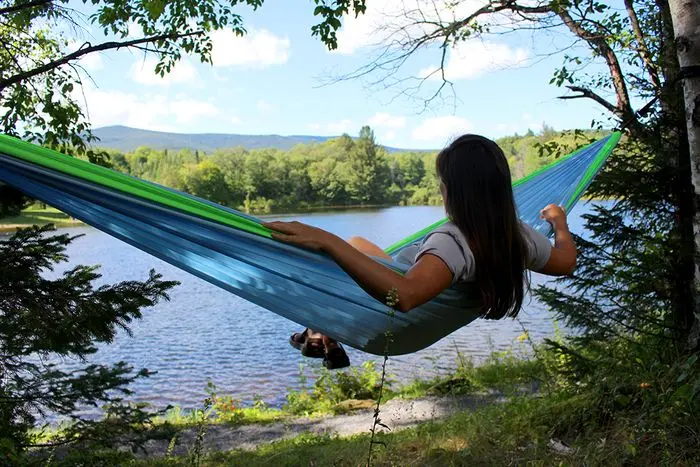
A fabric hammock is made from one or two guiding ropes (thick rope), on which a durable fabric (e.g., canvas) is stretched, with a width of 120-150 cm.
The fabric is gathered at both ends (with a knot) to form a cocoon shape (like a candy wrapper) and is hung on supports.
Cord Shape for Hammocks: Round or Flat
Round cords are traditionally used for weaving or knitting, but flat cords (without a core) are also quite strong and hold knots well.
Therefore, the shape of the cord for the hammock is a matter of taste and design.
Cord Material for Hammocks
Since the hammock is intended for people, it is natural to use natural materials, such as cotton.
Cotton cords are eco-friendly, breathable, soft for the body, and hold knots well.
However, cotton cord has its downsides – it is not very durable, may fade, and will not last long if the hammock is left outside all summer.
Cotton cord is ideal for a home hammock used indoors.
More “durable” options are synthetic cords, such as polyester, polypropylene, and nylon (capron).
Polyester cords are cheaper than cotton, but just as soft and easy to tie. Polyester cords are popular for weaving (knitting) rugs.
Polyester cords are resistant to the elements.
Polyester cord is a good option for outdoor home hammocks, especially for family use.
Polypropylene cords are slightly stiffer than cotton and polyester, with a smooth surface.
They are a bit more expensive than polyester. Hammocks made of polypropylene cords are suitable for areas where higher loads on the hammock are expected, such as public beaches, resorts, or sanatoriums.
Nylon (capron) cords are the strongest and stiffest. However, larger diameter nylon cords may not hold knots well.
For hammocks, it’s better to use nylon cords of smaller diameters (3-5 mm), preferably twisted (they are softer) rather than braided.
A hammock made of nylon cord will be strong, withstand rain, frost, and direct sunlight.
It is ideal for public places and sports facilities.
 🕘 Пн–Чт 9–18 | 🕔 Пт 9–17 | 🚫 Сб–Нд
 +38 (068) 325-62-09
 +38 (095) 127-41-92
 +38 (093) 651-05-48
 (044)251-04-68