
 +38(068) 325-62-09
 +38(095) 127-41-92
 +38(093) 651-05-48
 (044)251-04-68, (044)251-05-00
 Wicks for candles
Showing all 4 resultsSorted by latest
-

The wick for candles is 1 mm braided cotton spikes
108.00грн. -
Braided 1-3 mm cotton wick for candles
Price range: 1.08грн. through 1.80грн. Select options This product has multiple variants. The options may be chosen on the product page -
Wick for candles woven 1-3.5 mm cotton
Price range: 1.44грн. through 2.40грн. Select options This product has multiple variants. The options may be chosen on the product page -
The wick is cotton woven cotton
Price range: 0.60грн. through 1.50грн. Select options This product has multiple variants. The options may be chosen on the product page
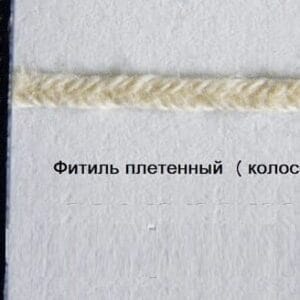


Wicks for candles from the manufacturer from the warehouse and to order.
A candle wick is a kind of capillary through which the melt of the candle mass enters the combustion zone. Wicks are woven from cotton threads.
PP Fofanov Y.S. manufactures and wholesales woven cotton wicks for candles. Types of wicks: woven round, braided, twisted. Wicks are made of cotton (cotton thread), braided wicks with standard diameters from 1 mm to 3.0 mm, twisted from 6 to 48 threads.
Wholesale sale of candle wicks, skeins from 100 m.
We fulfill orders from 1000 m for the manufacture of candle wicks from cotton: diameter, method of manufacture (twisting / weaving) and length – at the Customer’s choice.
The history of wicks
Where do candle wicks come from and how did they become a necessary element in candle making? This is an interesting story that originated in ancient times and continues to fascinate with its uniqueness.
Candle wicks are an integral part of the candle making process, helping them to retain their shape and keep the wick burning in the center. Their history goes back deep into the past, to the times when candles were used not only for lighting, but also in religious and ceremonial ceremonies.
The first candles were simple designs, where a wax wick was simply dipped into liquid wax or fat and was responsible for burning. However, the need arose for a stable way to hold the wick in place so that the candle would burn evenly and without interruption.
The first references to the use of wicks for candles belong to the ancient Greek and Roman periods. At that time, wicks were made of metal or stone. They were important not only for ensuring the stable burning of candles, but also performed religious symbolic functions.
Over the centuries, candle wicks have evolved, changing materials and shapes. In the Middle Ages, they began to be made of wood or metal, which greatly facilitated the process of making candles. Later, with the development of industry, cheaper materials such as metal wire or even paper began to be used.
Today, candle wicks can come in a wide variety of shapes and materials, including wax, metal, plastic, and even bioplastic. They play a key role in creating high-quality and aesthetically attractive candles that delight us with their light and aroma.
Thus, the history of candle wicks shows how small details can have a huge meaning in the culture and traditions of peoples around the world.

-
 Fishing cord for angling 1–1.5 mmPrice range: 120.00грн. through 306.00грн.
 -
Sewing thread no. 40, 5000 yards, 100% polyester S/260.00грн.
-
Linen twine cord polypropylene 3 mm 20 meters33.60грн.
-
Cotton braided tape (100% cotton) 6–8 mm, white, naturalPrice range: 96.00грн. through 102.00грн.
-
Braided Polypropylene Rope with Core (Heavy-Duty) 8–18 mmPrice range: 13.50грн. through 57.00грн.



 🕘 Пн–Чт 9–18 | 🕔 Пт 9–17 | 🚫 Сб–Нд
 +38 (068) 325-62-09
 +38 (095) 127-41-92
 +38 (093) 651-05-48
 (044)251-04-68